Kolbakhova S.N., Koneva E.S., Kulchitskaya D.B., Strukov R.N., Khaptagaev T.B. The use of stability training in rehabilitation programs in patients after total knee replacement in the late recovery period. Problems of Balneology, Physiotherapy and Exercise Therapy. 2022;99(6-2):31–35. DOI: 10.17116/kurort20229906231
Even several months after total knee arthroplasty, patients often still have impaired balance, asymmetric weight distribution, a pathological gait pattern and underloading of the operated limb. The authors tested whether biofeedback stability training could restore balance, movement symmetry, locomotor function and circulation in the operated limb.
Participants and groups
The study included 60 patients aged 55–80 years, assessed three months after lower-limb joint replacement. They were split into two groups of 30:
- the intervention group received exercise therapy, massage and biofeedback stability training;
- the comparison group received standard rehabilitation only.
How training was delivered
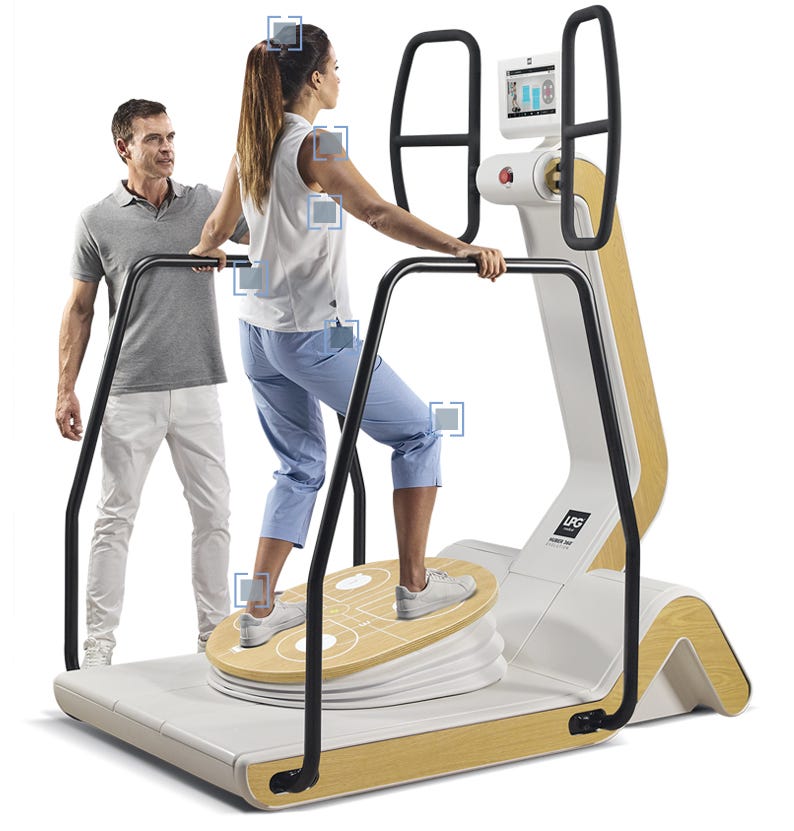
Patients stood on a stabilometric platform that recorded the projection of the centre of gravity. Visual biofeedback showed the task, the result and an immediate opportunity to correct posture. Sessions included standing balance, slow knee flexion, ball exercises and the Ballon protocol. The course consisted of 10 daily sessions.
Baseline findings
In quiet standing, load distribution was about 40% / 68% versus a normal 49% / 50%. The symmetry index was 0.78 ± 0.3 against a normal range of 0.95–1.0. During slow knee flexion the distribution remained asymmetric: 38 ± 2.7% / 62 ± 2.5%.
Results
- the symmetry index rose to 0.88 ± 0.5 in the intervention group versus 0.82 ± 0.6 in the comparison group;
- capillary blood flow in the operated limb improved on laser Doppler flowmetry;
- EQ-5D quality of life in the intervention group changed from 6.9 ± 0.7 to 4.2 ± 0.9 after the course and remained improved at 6 months (p < 0.001);
- anxiety and depression decreased significantly, with the effect lasting to 6 months.
The authors link the effect to better centre-of-gravity control, more symmetrical loading and recovery of a more physiological gait pattern.