He Lei, Chai Shuang-shuang, Chen Ya-ping. Effect of Balance Training with Balance Assessment Training System on Balance after Stroke. Chinese Journal of Rehabilitation Theory and Practice. 2021;27(7):760–764. DOI: 10.3969/j.issn.1006-9771.2021.07.004
Researchers tested whether HUBER 360 can improve post-stroke balance disorders. Sixteen patients after a first stroke were randomised to a control group (n = 8) or a HUBER group (n = 8). Both groups received usual motor training; the experimental group also trained on HUBER 360 for 3 weeks.
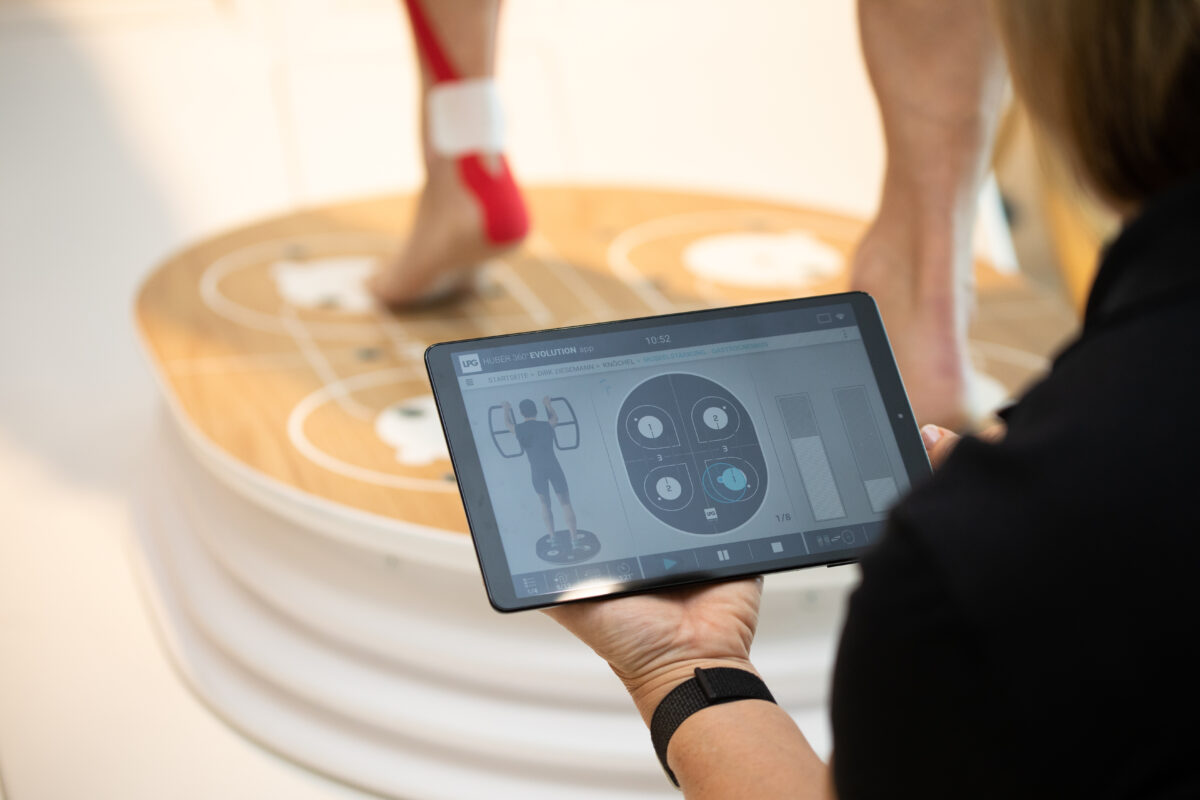
HUBER 360 protocol
After functional testing, patients trained on an unstable moving platform targeting postural control, proprioception, weight shifting, coordination and centre-of-gravity control. The platform moved in eight directions — forward, back, left, right and four diagonals. Load progressed from low to high: about 5 minutes per level, around 30 minutes in total, twice a day, 5 days a week for 3 weeks.
Outcome measures
- Berg Balance Scale;
- HUBER 360 stabilometry: centre-of-pressure motion, stability and response to instability;
- 10-metre walk test;
- Timed Up & Go.
Results
Berg Balance Scale: control 31.00 ± 3.78 → 37.13 ± 2.42 (+6.13), HUBER 31.38 ± 3.02 → 41.50 ± 3.07 (+10.12; +32.2% from baseline). Between-group difference after treatment: p = 0.006.
Eyes-closed centre-of-pressure path decreased by about 26.4% in the HUBER group versus 13.8% in controls (p = 0.020). Walking and TUG also improved in both groups, with a statistically greater gain after HUBER (p < 0.05).
Adding HUBER 360 to standard motor training after stroke produced greater improvements in functional balance and objective stabilometric measures.